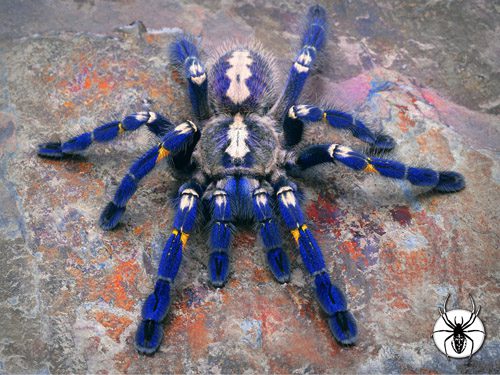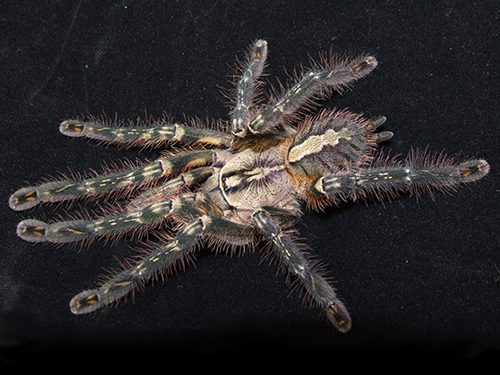
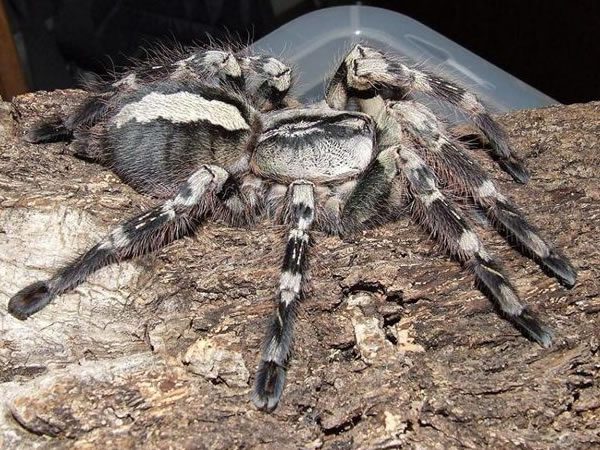
ENVIRONMENT
Core care conditions
Use these ranges as a starting point and adjust for life stage, enclosure ventilation and observed behaviour.
HUSBANDRY OVERVIEW
At a glance
- Taxonomic group
- Arachnida
- Origin
- Sri Lanka
- Lifestyle
- Arboreal
- Adult size (diagonal leg span)
- 18–20 cm
- Temperament
- Defensive
- Experience level
- Advanced
- Visibility
- Occasionally visible
- Burrowing
- Does not burrow
- Growth rate
- Fast
- Urticating hairs
- No
- Venom
- Medically significant
- Tarantula region
- Old World
- Male lifespan
- 3–4 years
- Female lifespan
- 10–15 years (up to 12–15+ years)
CARE NOTES
Keeping considerations
Provide vertically oriented cork bark flats or tubes as a primary retreat. Keep a catch cup and long tongs handy during maintenance.
PRACTICAL HUSBANDRY
Day-to-day care
Diet & prey
Crickets, roaches, locusts (scaled to spider size)
Feeding
Once weekly for juveniles/sub-adults; every 10–14 days for adults
Enclosure
Arboreal setup; tall vertical enclosure with minimum dimensions roughly $3 \times$ diagonal leg span (DLS) in height, secure latch, and cross-ventilation.
Substrate
Coconut fiber or peat mix, kept lightly moist (held damp in lower layers for humidity).
Ventilation
Good cross-ventilation is vital to prevent stagnant air.
Hydration & misting
Provide a shallow water dish; lightly mist one side of the enclosure or the web occasionally to maintain 65–75% humidity.
Handling
Strictly no handling (extremely fast with medically significant venom and defensive posture).
Sex differences
Females grow larger, have a longer lifespan, and exhibit more robust patterns; males are lanky and develop tibial hooks upon ultimate molt.
IMPORTANT CONSIDERATIONS
Keeper notes
Possesses potent venom and lightning-fast teleportation speeds. Teleportation/bolting behavior combined with arboreal agility requires extreme caution during maintenance.
BREEDING & LIFE CYCLE
Breeding notes
Typical arboreal sac production; ensure female is well-fed prior to introduction to reduce cannibalism risks.
SOURCES & FURTHER READING
Check the references
Care can vary by species, life stage and local conditions. Review multiple reputable sources before making husbandry decisions.
Last reviewed:
KEEP EXPLORING
More Poecilotheria
Other completed care guides from the same scientific genus.