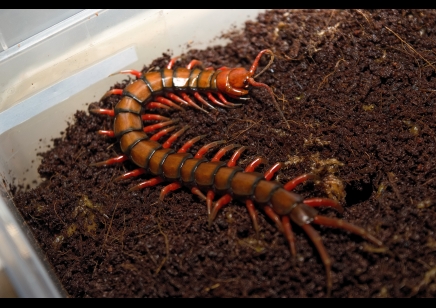
SPECIES CARE GUIDE
Malaysian Jewel Centipede
Scolopendra sp. “Jewel”

ENVIRONMENT
Core care conditions
Use these ranges as a starting point and adjust for life stage, enclosure ventilation and observed behaviour.
HUSBANDRY OVERVIEW
At a glance
- Taxonomic group
- Chilopoda
- Origin
- Malaysian highlands
- Lifestyle
- Terrestrial
- Adult size (body / total length)
- 20–30 cm
- Temperament
- Fast and aggressive
- Experience level
- Advanced
- Burrowing
- Will burrow
- Venom
- Medically significant
CARE NOTES
Keeping considerations
Scolopendra sp. “Jewel” is an unidentified Malaysian highland form requiring cooler, humid conditions. House it alone in a large, highly secure terrestrial enclosure with deep lightly moist substrate, a hide, water dish and strong ventilation. Maintain the locality separately and never hybridise it with other Scolopendra forms.
PRACTICAL HUSBANDRY
Day-to-day care
Diet & prey
Crickets, roaches, locusts and other appropriately sized invertebrate prey
Feeding
Offer one appropriately sized prey item at a time, adjusting frequency to body condition. Remove uneaten prey and food remains promptly.
Enclosure
A spacious, escape-proof terrestrial enclosure with a tightly secured lid, deep substrate, a cork-bark hide and enough floor area for the adult's full length.
Substrate
Deep, lightly compacted moisture-retentive substrate, such as soil and coco fibre, with leaf litter and moss. Keep it lightly moist rather than saturated.
Ventilation
Provide strong cross-ventilation while retaining a humid lower substrate. Avoid stagnant, waterlogged conditions.
Hydration & misting
Provide a clean, shallow water dish at all times. Keep part of the substrate lightly moist and monitor juveniles carefully because they dehydrate readily.
Handling
Do not handle. Use long tools, a secure catch container and a second barrier during feeding, cleaning or rehousing.
Sex differences
No reliable external method is available for visually sexing this form.
IMPORTANT CONSIDERATIONS
Keeper notes
Extremely fast, aggressive and capable of delivering a very painful, medically significant bite. It is also a powerful escape artist. Never handle and keep the enclosure securely locked.
BREEDING & LIFE CYCLE
Breeding notes
Wild-caught females may arrive gravid and can produce a clutch the following year. Young leave the mother at about 5 cm and require reliably humid conditions because they are prone to dehydration. Do not cross this locality with other Asian forms.
SOURCES & FURTHER READING
Check the references
Care can vary by species, life stage and local conditions. Review multiple reputable sources before making husbandry decisions.
KEEP EXPLORING
More Scolopendra
Other completed care guides from the same scientific genus.