SPECIES CARE GUIDE
Murray Banded Huntsman
Holconia murrayensis
ENVIRONMENT
Core care conditions
Use these ranges as a starting point and adjust for life stage, enclosure ventilation and observed behaviour.
HUSBANDRY OVERVIEW
At a glance
- Taxonomic group
- Arachnida
- Origin
- Australia (South Australia, Victoria and New South Wales; Murray River basin)
- Lifestyle
- Arboreal
- Adult size (diagonal leg span)
- 10–17 cm
- Temperament
- Fast / skittish
- Experience level
- Intermediate
- Visibility
- Occasionally visible
- Burrowing
- Does not burrow
- Venom
- Mild
CARE NOTES
Keeping considerations
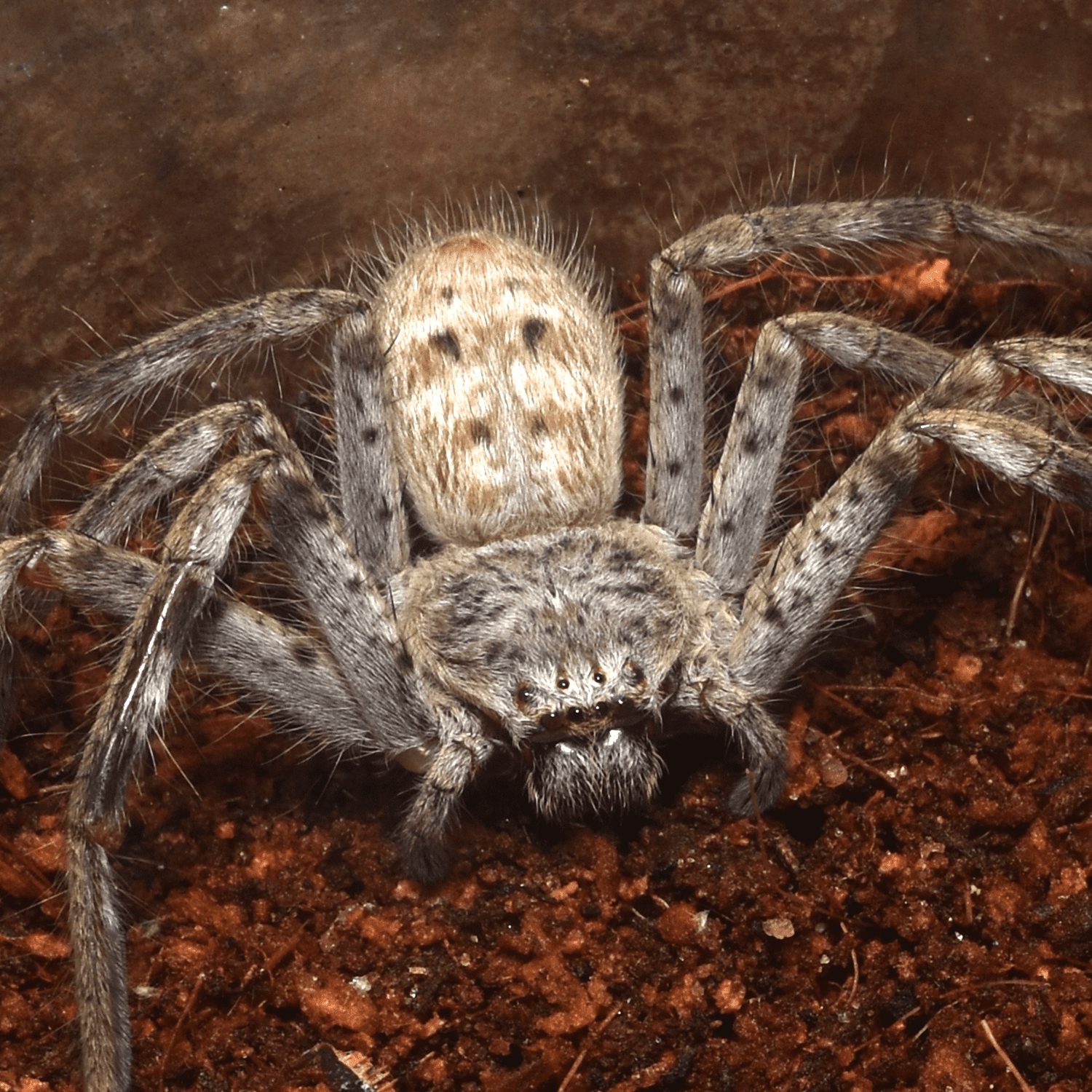
A large nocturnal huntsman adapted to narrow spaces beneath loose bark. Furnish the enclosure with upright cork bark and close-fitting retreats that suit its flattened body. Maintain warmth with a moderate moisture gradient rather than continuously wet conditions. This is a solitary, active predator and should be housed individually.
PRACTICAL HUSBANDRY
Day-to-day care
Diet & prey
Crickets, roaches, locusts, moths and other appropriately sized live insects
Feeding
Offer suitably sized live prey once or twice weekly, adjusting to body condition and life stage. Remove uneaten prey, especially during moulting.
Enclosure
A secure, vertically oriented enclosure with ample climbing space, upright cork bark and tight bark-like retreats. Allow enough width for the adult leg span and room to moult safely.
Substrate
A shallow layer of soil or coco-fibre mix to retain a slight moisture gradient; avoid keeping the enclosure wet.
Ventilation
Strong cross-ventilation is important. Use a well-ventilated enclosure that does not allow humid, stagnant air to build up.
Hydration & misting
Provide a small shallow water dish. Lightly mist one side or part of the cork bark as needed, allowing the enclosure to dry between applications and avoiding saturation.
Handling
Best kept as an observation-only species. It is fast, agile and capable of sudden bursts of speed, making handling and open-container interaction risky.
Sex differences
Mature males are generally slimmer and leggier, while females are more robust-bodied.
ENCLOSURE EXAMPLE · AD · AFFILIATE LINK
Recommended arboreal enclosure
Such as The Spider Shop Acrylic Arboreal Terrarium ↗
An example with size options. Check the selected size, ventilation and security against this species and life stage.
IMPORTANT CONSIDERATIONS
Keeper notes
Extremely quick and an accomplished climber. Use a secure, escape-proof enclosure and take care during feeding or maintenance. Bites should be avoided and may cause pain and local effects.
SOURCES & FURTHER READING
Check the references
Care can vary by species, life stage and local conditions. Review multiple reputable sources before making husbandry decisions.
KEEP EXPLORING
More true spiders
Related completed care guides from the true spiders library.