SPECIES CARE GUIDE
Chinese Hourglass Spider
Cyclocosmia ricketti
ENVIRONMENT
Core care conditions
Use these ranges as a starting point and adjust for life stage, enclosure ventilation and observed behaviour.
HUSBANDRY OVERVIEW
At a glance
- Taxonomic group
- Arachnida
- Origin
- China
- Lifestyle
- Fossorial
- Adult size (body / total length)
- 2.5–3 cm
- Temperament
- Defensive
- Experience level
- Advanced
- Visibility
- Low
- Burrowing
- High
- Growth rate
- Slow
CARE NOTES
Keeping considerations
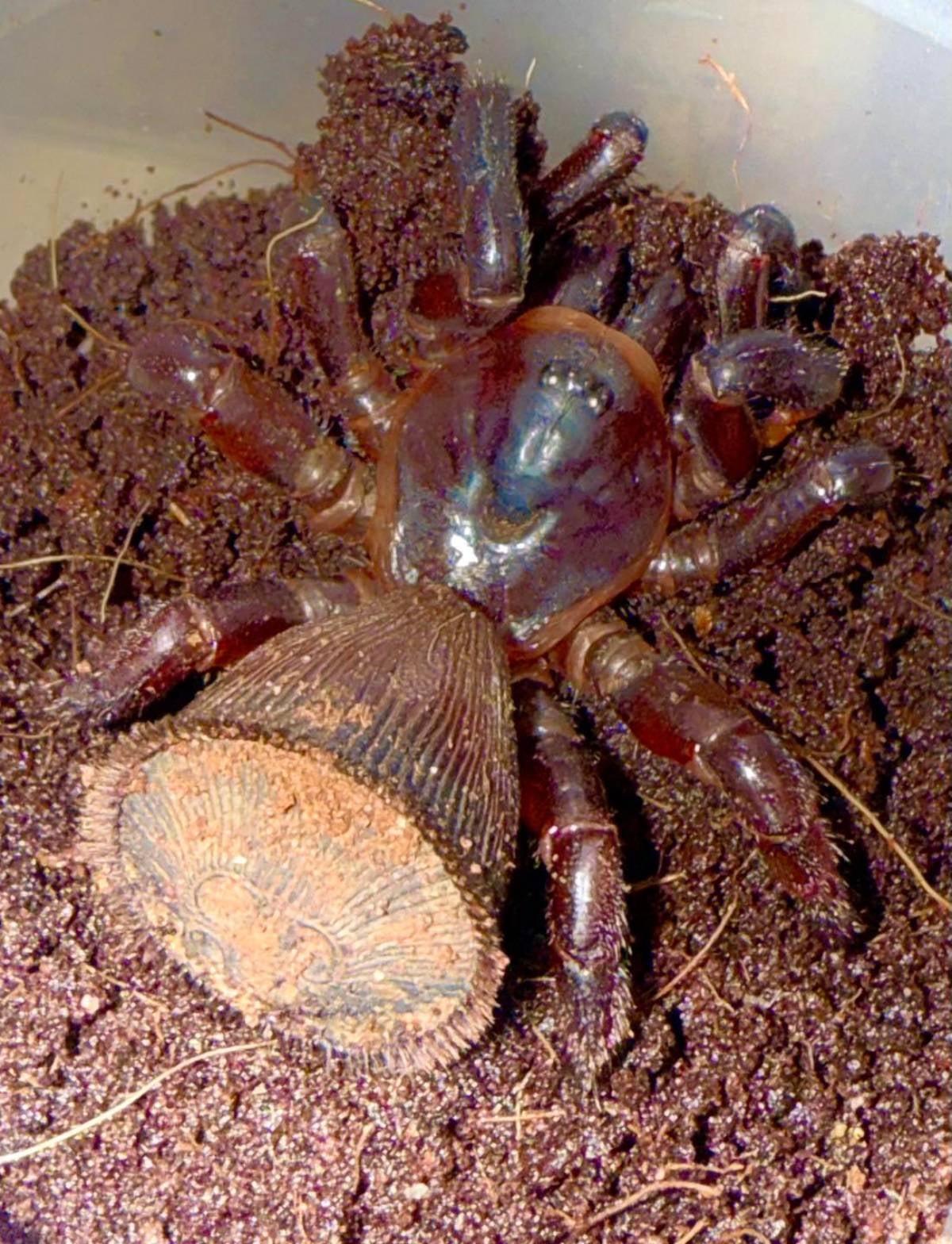
Cyclocosmia ricketti is a Chinese trapdoor spider famous for its remarkable flattened, hardened abdominal disc, which resembles an engraved coin or Oreo biscuit. When threatened it retreats into its vertical silk-lined burrow and blocks the opening with the disc, a defence called phragmosis. This is a specialist display animal for keepers happy to see little of the spider. Stable deep substrate and careful moisture management matter far more than decorative enclosure space. Published female body length is about 28 mm; the disc can be around 16 mm across.
PRACTICAL HUSBANDRY
Day-to-day care
Diet & prey
Appropriately sized captive-bred crickets, small roaches and other soft-bodied feeder insects.
Feeding
Offer appropriately sized prey at or near the burrow entrance, generally once weekly for growing spiders and less often for adults according to appetite and body condition. Avoid repeatedly digging out or exposing the spider. Remove uneaten prey promptly, especially during premoult; never leave live insects with a moulting individual.
Enclosure
Deep, secure terrestrial enclosure designed primarily for a stable vertical burrow. A floor area around 20 × 30 cm can suit an adult if accompanied by at least 20 cm of diggable substrate and safe access for maintenance; scale smaller for juveniles. A deep container with a tight-fitting lid, discreet surface cover and a shallow water dish is preferable to a shallow display box.
Substrate
Use at least 20 cm of compactable, slightly moist burrow-holding substrate, such as pesticide-free topsoil or forest humus mixed with a modest amount of sand/clay for structure. Pre-form a narrow starter hole and offer moss or leaf litter as surface cover. Maintain the burrow walls against collapse; avoid loose dry coir alone.
Ventilation
Provide gentle, effective ventilation while preventing stagnant, saturated conditions. Retain some moisture in the deeper substrate without flooding the burrow. Small vents must be escape-proof, especially for young specimens.
Hydration & misting
Maintain a modestly moist lower soil layer and a humidity gradient, rather than keeping the entire surface waterlogged. Add small amounts of water to one side when needed; a shallow clean water dish is helpful where safely accessible. Avoid pouring water directly into an occupied burrow. Monitor actual substrate moisture, not just air humidity.
Handling
Do not handle or attempt to prise the spider from its burrow. This is a highly secretive ambush predator and should be observed at the entrance if visible. For transfers, move the substrate and retreat carefully into a prepared secure container when possible.
Sex differences
Females have a famously broad, hardened, patterned abdominal disc and remain within their burrows. Mature males may wander in search of mates and differ in proportions. Reliable sex and species identification require appropriate morphological examination rather than the disc pattern alone.
IMPORTANT CONSIDERATIONS
Keeper notes
Not a tarantula: family Halonoproctidae. Highly specialised fossorial spider that can remain unseen for long periods. Do not handle or excavate casually; defendable bite risk and extreme sensitivity to burrow collapse or flooding. Do not assume a photographed Cyclocosmia is C. ricketti without verified identification, as similar species exist.
BREEDING & LIFE CYCLE
Breeding notes
Solitary trapdoor spider; house individually. Captive breeding details for this species are limited. Pairing should be undertaken only by specialists because disturbance, burrow destruction and cannibalism are significant risks.
SOURCES & FURTHER READING
Check the references
Care can vary by species, life stage and local conditions. Review multiple reputable sources before making husbandry decisions.
KEEP EXPLORING
More Cyclocosmia
Other completed care guides from the same scientific genus.