SPECIES CARE GUIDE
Vietnamese Hourglass Spider
Cyclocosmia latusicosta

ENVIRONMENT
Core care conditions
Use these ranges as a starting point and adjust for life stage, enclosure ventilation and observed behaviour.
HUSBANDRY OVERVIEW
At a glance
- Taxonomic group
- Arachnida
- Origin
- China and Vietnam
- Lifestyle
- Fossorial
- Adult size (body / total length)
- 3–5 cm
- Temperament
- Shy
- Experience level
- Advanced
- Visibility
- Low
- Burrowing
- High
- Growth rate
- Slow
CARE NOTES
Keeping considerations
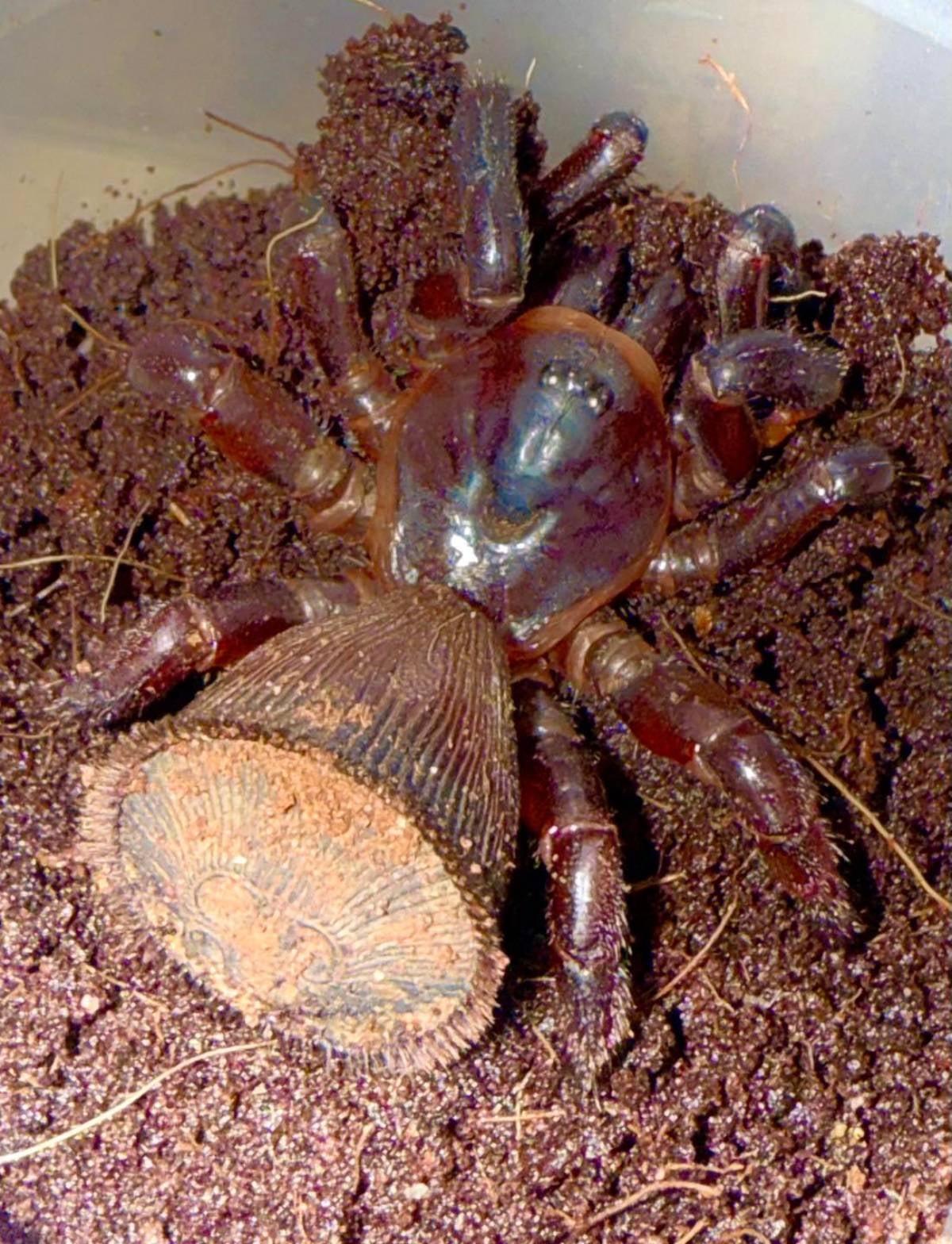
Cyclocosmia latusicosta is a remarkable trapdoor spider from southern China and Vietnam. It has a hardened, deeply grooved, circular rear abdominal disc resembling a coin or Oreo biscuit. The spider can retreat into its vertical tunnel and use the disc as a protective plug (phragmosis). A successful setup prioritises deep compacted earth, stable moisture, a starter burrow and minimal disturbance. It may be almost permanently invisible in a well-designed enclosure. Published husbandry temperatures differ; monitor the spider, avoid excessive heat and follow the needs of its individual locality and life stage.
PRACTICAL HUSBANDRY
Day-to-day care
Diet & prey
Appropriately sized captive-bred crickets, small roaches and other suitable feeder insects.
Feeding
Offer a modest feeder near the burrow entrance, usually around once weekly for juveniles and less often for established adults depending on appetite. This is a patient ambush predator; it may take prey unseen from beneath its trapdoor. Remove uneaten prey promptly and stop offering live insects during premoult or until the spider has hardened after moulting. Do not dig up the burrow to check appetite.
Enclosure
Provide a secure, vertically deep terrestrial enclosure built around substrate rather than open display space. Approximately 20 × 20 × 30 cm can suit an adult with at least 15–20 cm, ideally more, of diggable soil. A well-packed starter shaft beneath a concealed surface, a safe water source and secure small ventilation holes are useful.
Substrate
At least 15–20 cm of compactable, moisture-retaining pesticide-free soil/forest humus with some clay or peat/coir component for stability. The soil should hold a vertical tunnel without collapse and remain gently moist, never muddy. A preformed starter burrow and surface leaf litter or moss help natural construction and camouflage.
Ventilation
Use moderate cross-ventilation and secure fine openings. Keep the burrow substrate consistently slightly moist but avoid sealed stagnant air, mould growth, waterlogging and large rapid temperature changes.
Hydration & misting
Keep deeper substrate lightly moist through careful watering at the side of the enclosure; do not pour water into an occupied burrow. A shallow water dish can be provided where practical. Monitor moisture in the soil rather than relying solely on relative humidity readings, and never allow the tunnel to flood.
Handling
Observation only. The animal is extremely secretive and may remain underground for long periods. Never prise it out of a burrow or try to lift the abdominal disc. Rehouse by carefully transferring the occupied burrow structure where possible, using a secure container and avoiding injury.
Sex differences
Females tend to remain settled within permanent burrows and may survive many years. Mature males are generally more mobile and may have different proportions. Accurate sexing and identification require specialist examination; a disc photograph alone is not sufficient to separate all Cyclocosmia species.
IMPORTANT CONSIDERATIONS
Keeper notes
Not a tarantula; family Halonoproctidae. A secretive true spider that needs a deep stable moist burrow. Avoid unnecessary excavation, falls, flooding, desiccation, free handling and keeping multiple individuals together. Cyclocosmia species are visually similar and can be misidentified in the pet trade.
BREEDING & LIFE CYCLE
Breeding notes
Solitary species: house individuals separately. Captive breeding data are limited, and the spider depends strongly on an established retreat. Any pairing should be reserved for experienced specialists because disturbance and cannibalism are possible.
SOURCES & FURTHER READING
Check the references
Care can vary by species, life stage and local conditions. Review multiple reputable sources before making husbandry decisions.
KEEP EXPLORING
More Cyclocosmia
Other completed care guides from the same scientific genus.