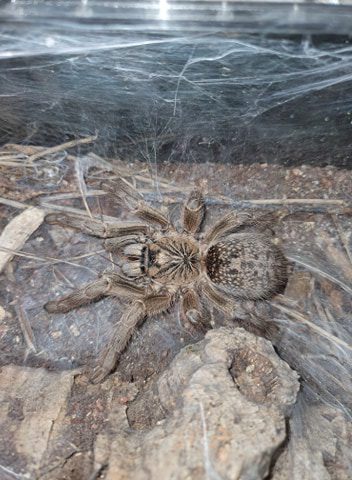
SPECIES CARE GUIDE
Namaqua Baboon
Harpactira namaquensis

ENVIRONMENT
Core care conditions
Use these ranges as a starting point and adjust for life stage, enclosure ventilation and observed behaviour.
HUSBANDRY OVERVIEW
At a glance
- Taxonomic group
- Arachnida
- Origin
- Namibia and South Africa
- Lifestyle
- Terrestrial
- Adult size (diagonal leg span)
- 10–12 cm
- Temperament
- Skittish
- Experience level
- Intermediate
- Visibility
- Occasionally visible
- Burrowing
- Moderate burrower
- Growth rate
- Moderate
- Urticating hairs
- No
- Venom
- Potent
- Tarantula region
- Old World
CARE NOTES
Keeping considerations
Harpactira namaquensis is an Old World baboon spider from the dry Namaqualand region of Namibia and South Africa. It is a terrestrial species that commonly constructs a silk-lined burrow or retreat beneath cover, using it to escape exposed heat and dry surface conditions. Provide a low enclosure with deep, firm substrate, a starter retreat, fresh water and strong airflow. Keep the surface mainly dry while allowing a small, slightly more buffered zone low in one corner. Avoid evenly damp substrate and frequent misting. Seasonal and night-time cooling is normal within its native range, so chronic high heat is unnecessary. It is often described as less defensive than some African baboon spiders, but it remains fast and capable of biting. Individual temperament varies, and maintenance should always be planned around long tools and a catch cup.
PRACTICAL HUSBANDRY
Day-to-day care
Diet & prey
Appropriately sized crickets, roaches, locusts and mealworms; tiny live or pre-killed prey for spiderlings.
Feeding
Offer spiderlings small prey once or twice weekly, juveniles every 7–10 days and adults every 10–14 days. Adjust to abdomen condition and appetite. Remove uneaten prey within 24 hours. Stop feeding during premoult and resume only after the fangs have hardened following a moult.
Enclosure
Use a secure, low terrestrial enclosure with approximately 30 × 30 cm floor space for an adult and enough depth for at least 12–15 cm of substrate. Include a shallow water dish, a cork-bark hide and a starter burrow. Keep empty height low to reduce fall risk.
Substrate
Provide 12–15 cm or more of firmly packed, diggable substrate such as fertiliser-free topsoil mixed with a little coir, clay or fine sand. The mix must hold a tunnel; never use loose sand alone. Keep the surface mostly dry, with only a small moisture reserve in one lower corner.
Ventilation
Provide strong cross ventilation above the substrate and a well-ventilated lid. This dry-region species should not be kept in stale, humid air. Persistent condensation, mould or a musty smell indicates excess moisture or inadequate airflow.
Hydration & misting
Keep a clean, shallow water dish available. Occasionally overflow a small amount into one corner if the lower substrate becomes completely dry. Avoid routine misting, wetting the entire enclosure or spraying the spider directly.
Handling
Observation only; do not handle. Use long tools for maintenance and keep hands away from the retreat. Rehouse inside a larger escape-resistant container with a catch cup ready, because even a calm individual can bolt or defend itself without warning.
Sex differences
Mature males are generally slimmer and leggier than females, while females are more robust. Confirm sex from a suitable moult or mature sexual structures rather than colour or size alone.
ENCLOSURE EXAMPLE · AD · AFFILIATE LINK
Recommended terrestrial enclosure
Such as The Spider Shop Invertarium Setup ↗
An example with size options. Check the selected footprint, fall height, ventilation and substrate depth for this animal.
IMPORTANT CONSIDERATIONS
Keeper notes
Fast Old World tarantula with no urticating hairs. It may retreat when disturbed but can use a threat posture or bite if cornered; treat its venom as potentially significant. Do not handle, prevent escapes and never dig out a sealed retreat merely to check the spider.
BREEDING & LIFE CYCLE
Breeding notes
Keep individually. Pair only verified mature specimens under close supervision, with a well-established female retreat and a clear route for removing the male. Separate promptly if either spider becomes defensive; cannibalism is possible.
SOURCES & FURTHER READING
Check the references
Care can vary by species, life stage and local conditions. Review multiple reputable sources before making husbandry decisions.
KEEP EXPLORING
More Harpactira
Other completed care guides from the same scientific genus.