SPECIES CARE GUIDE
Singapore Blue Tarantula
Omothymus violaceopes

ENVIRONMENT
Core care conditions
Use these ranges as a starting point and adjust for life stage, enclosure ventilation and observed behaviour.
HUSBANDRY OVERVIEW
At a glance
- Taxonomic group
- Arachnida
- Origin
- Peninsular Malaysia and Singapore
- Lifestyle
- Arboreal
- Adult size (diagonal leg span)
- 20–25 cm
- Temperament
- Fast / defensive
- Experience level
- Advanced
- Visibility
- Often hidden
- Burrowing
- May burrow
- Growth rate
- Fast
- Urticating hairs
- Absent
- Venom
- Medically significant
- Tarantula region
- Old World
- Male lifespan
- 4–5 years
- Female lifespan
- 12–15 years
CARE NOTES
Keeping considerations
This large arboreal species naturally occupies holes and deep recesses in mature tree trunks. Give it a dark vertical retreat and leave established webbing intact. Balance a moist lower substrate with excellent airflow and a drier upper surface. It is generally reclusive by day and more active after dark.
PRACTICAL HUSBANDRY
Day-to-day care
Diet & prey
Roaches, crickets, locusts and other appropriately sized captive-bred insects
Feeding
Offer slings small prey every 4–7 days, juveniles once or twice weekly and adults a suitably sized meal about every 10–14 days, adjusting for body condition. Remove uneaten prey within 24 hours and never leave prey with a moulting spider.
Enclosure
A tall, secure arboreal enclosure with an upright cork-bark tube or slab, additional webbing anchors and enough vertical room to move safely. An adult generally requires at least around 30 × 30 × 45 cm.
Substrate
Provide roughly 5–10 cm of moisture-retentive soil or coco-fibre mix. Keep the lower layers slightly damp while allowing the exposed surface to dry somewhat.
Ventilation
Strong cross-ventilation is essential, ideally at both lower and upper levels. Maintain moisture without creating stagnant air or persistent condensation.
Hydration & misting
Keep a fresh shallow water dish available. Overflow it lightly or dampen one lower corner as required, then allow exposed surfaces to dry; do not keep the whole enclosure wet.
Handling
Observation only. This species is extremely fast, defensive and capable of sudden bolting. Use long tools, a catch cup and a clear maintenance plan.
Sex differences
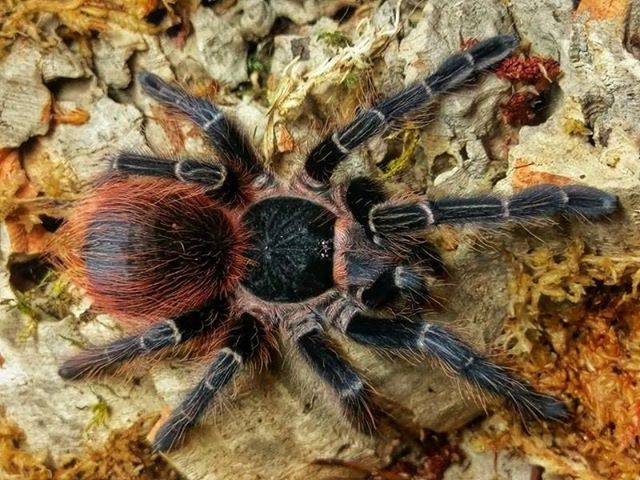
Females and juveniles are vivid violet-blue and more robust. Mature males become brown to olive, are slimmer and leggier, and develop mature-male structures.
ENCLOSURE EXAMPLE · AD · AFFILIATE LINK
Recommended arboreal enclosure
Such as The Spider Shop Acrylic Arboreal Terrarium ↗
An example with size options. Check the selected size, ventilation and security against this species and life stage.
IMPORTANT CONSIDERATIONS
Keeper notes
A very fast, defensive Old World tarantula with medically significant venom and no urticating hairs. Bites may cause severe pain and systemic symptoms. Use an escape-proof enclosure and avoid free-handling.
SOURCES & FURTHER READING
Check the references
Care can vary by species, life stage and local conditions. Review multiple reputable sources before making husbandry decisions.
KEEP EXPLORING
More tarantulas
Related completed care guides from the tarantulas library.